Post 15A · Engineering Authority
New bags. Old cages.
Filter cages — why new bags should not go onto worn cages
0 comments on this post.
New bags. Old cages.
The bag always loses that argument.
Four cages. Chosen by the gas.
Finished to the duty: heat-resistant aluminium or black paint, dry powder coating, or electroplating.
Zinc-protected, with the welds touched up after fabrication.
Pickled. For damp and mildly corrosive gas.
Pickled. For the harsher, more corrosive duties.
Making cages since 2001, alongside the bags they carry.
Talk to our technical team.
Caption
The shutdown is over and the new bags are in, and a good number of them have gone straight back onto the cages that ruined the last set.
It is worth being clear about what a cage actually does inside a pulse-jet baghouse, because it is easy to think of it as a passive support. While the plant is filtering, the gas pushes the bag inward against the cage wires. When the cleaning pulse fires, the bag snaps outward, and then it falls back onto those same wires. That happens on every cleaning cycle, over and over, for the whole working life of the bag. The cage is the one surface the filter media touches again and again, and whatever condition it is in, the bag has to live with it.
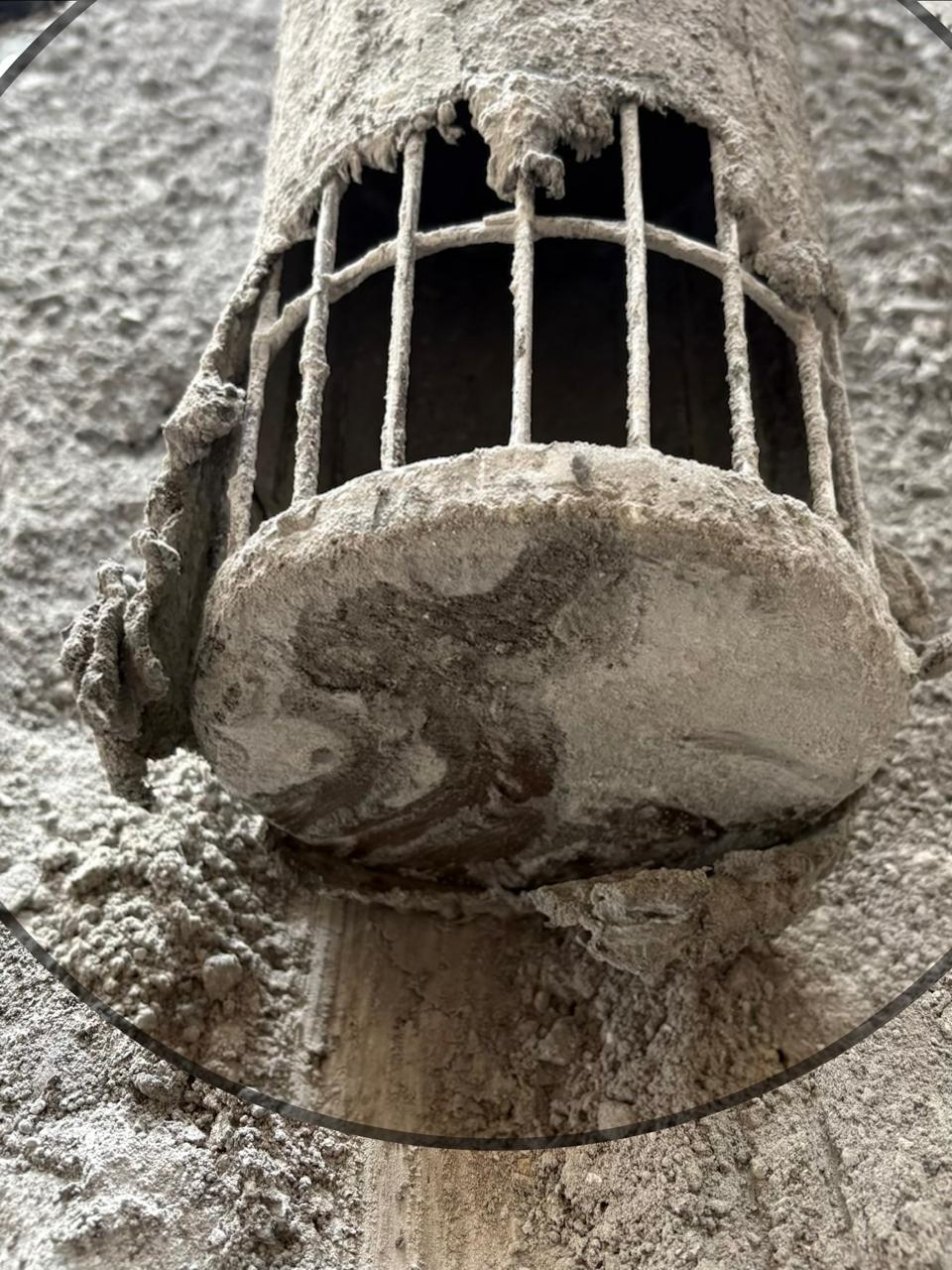
A cage in good condition gives the bag a smooth, even surface to land on. A cage that has been through a few campaigns rarely does. Wires bend, welds develop rough edges, coatings wear through and corrosion pits begin to form, and every one of those spots becomes a place where the bag is rubbed each time it moves. The damage usually shows up first at the bottom of the bag, where the fabric meets the last ring of the cage and the bottom pan, and it grows until the felt wears right through and the cage itself is showing, which is exactly what you can see in the photograph above. When it does not start at the bottom, it tends to appear as thin patches and holes running in straight lines down the length of the bag, exactly where the wires sat.
This is why fitting new bags onto old cages is one of the most expensive economies in a baghouse. The new bag inherits every flaw of the old cage from its first day in service, and it begins to wear in the same places as the bag it replaced. We said on Monday that the most useful thing to do during a shutdown is to check the cage welds and the coating at the contact points. This is why.
The other half of the decision is the material, and that is set by the gas rather than by the budget. We make cages in four materials. Mild steel is the workhorse, and we finish it to suit the duty it is going into, with heat-resistant aluminium or black paint, dry powder coating, or electroplating. Galvanised iron carries its own zinc protection, and we touch up the welds after fabrication so that the protection is continuous. Where the gas is damp or corrosive, we move to stainless steel: grade 304 for most of those duties, and grade 316 where the conditions are harsher still. Both stainless grades are pickled after fabrication, which cleans the surface left behind by welding so that the steel can resist corrosion the way it is supposed to.
We have been making cages since 2001, and we make them alongside the bags they carry and the filter media those bags are cut from. That matters more than it sounds. A cage and a bag that are specified together fit together, with the right diameter, the right number of wires and the right length, and a poor fit between the two is one of the quieter reasons bags fail early.
If your shutdown inspection turned up worn, bent or corroded cages, send us a photograph and the cage drawing, and we will tell you what we would replace them with.
Talk to our technical team.
#FilterCages #CagesSupplier #Cestelli #PulseJetBaghouse #SteelIndustry #Europe